


Almond Butter Factory Setup: Industrial Production Guide
 Jul29, 2026
 By lisa
Almond butter factory setup is an important step for businesses planning to enter industrial nut butter production. This successful factory requires more than simply purchasing processing equipment. Production capacity, processing flow, factory layout, product requirements, and future expansion should all be considered in advance to build an efficient and stable almond butter manufacturing operation.

Defining Production Scale and Product Positioning
Before setting an almond butter factory, it is essential to determine the target market and product positioning. For instance, the facility might produce pure almond butter, flavored almond butter, or serve as an ingredient supplier for the baking, confectionery, and ice cream industries. Different products entail varying requirements regarding texture (smoothness), oil content, and production capacity.
At the same time, production capacity such as 300 kg/h, 500 kg/h, 1,000 kg/h, or higher should be determined based on market demand. The rational capacity plan not only helps optimize the initial investment in equipment but also leaves room for future production expansion.
Designing an Optimized Almond Butter Production Process
This complete industrial almond butter production process typically involves the following steps: Almond screening and impurity removal, roasting, cooling, skin peeling (optional), coarse grinding, fine grinding, blending and mixing, vacuum degassing, finished product storage, filling and packaging.
Continuous almond butter production reduces manual labor, boosts efficiency, and effectively minimizes the risk of cross-contamination. For commercial-scale operations, automated production lines offer significant cost advantages over standalone machinery.
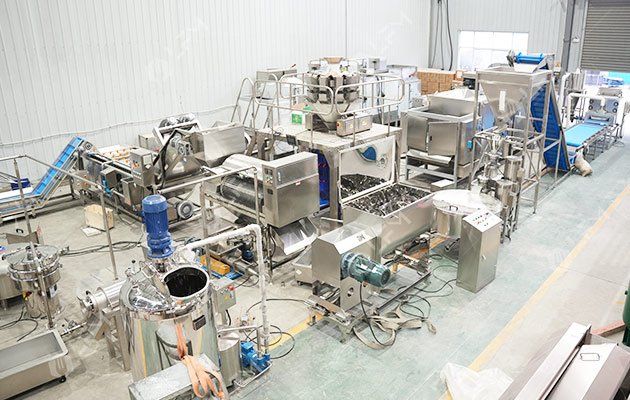
Almond Butter Factory Setup with Almond Butter Production Equipment
- Almond Roasting Machine
- Cooling Conveyor
- Almond Peeling Machine (Optional)
- Nut Butter Grinder
- Mixing Tank
- Vacuum Degassing Tank
- Storage Tank
- Filling Machine
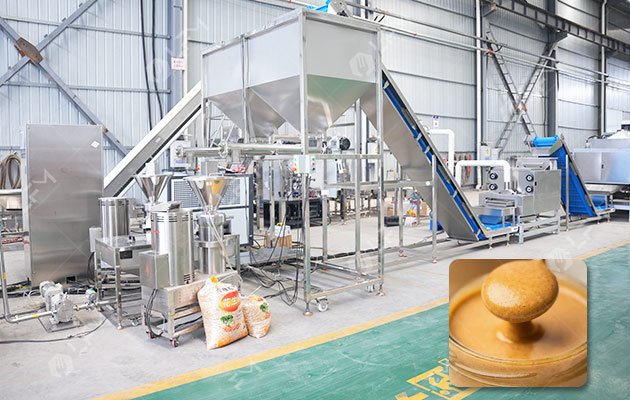
Among these, the roaster and the grinder are the critical pieces of equipment that determine the quality of the almond butter. Precise temperature control ensures the almonds develop a rich aroma and uniform color, while a high-quality colloid mill enables multi-stage grinding, resulting in a product with a fine, smooth texture.
Optimizing Factory Layout to Boost Production Efficiency
When an almond butter factory setup, it is advisable to organize functional zones such as areas for raw materials, roasting, grinding, blending, filling, and packaging, to ensure a unidirectional flow of materials and prevent cross-contamination between raw ingredients and finished products. Additionally, space should be allocated for equipment maintenance and future capacity expansion to facilitate subsequent upgrades.
Furthermore, equipment components that come into contact with food should be constructed from 304 stainless steel and supported by comprehensive cleaning and sanitation management systems to meet the safety standards required by modern food processing enterprises.
The industrial almond butter production line should utilize a PLC-based automatic control system to enable the automatic adjustment of parameters such as temperature, processing time, grinding fineness, and conveying speed.
Automated production not only ensures consistent quality across batches of almond butter but also reduces labor requirements and maximizes equipment utilization. For medium-to-large-scale factories, automated production lines can significantly enhance overall operational efficiency and return on investment.

 Prev:
Prev:


